
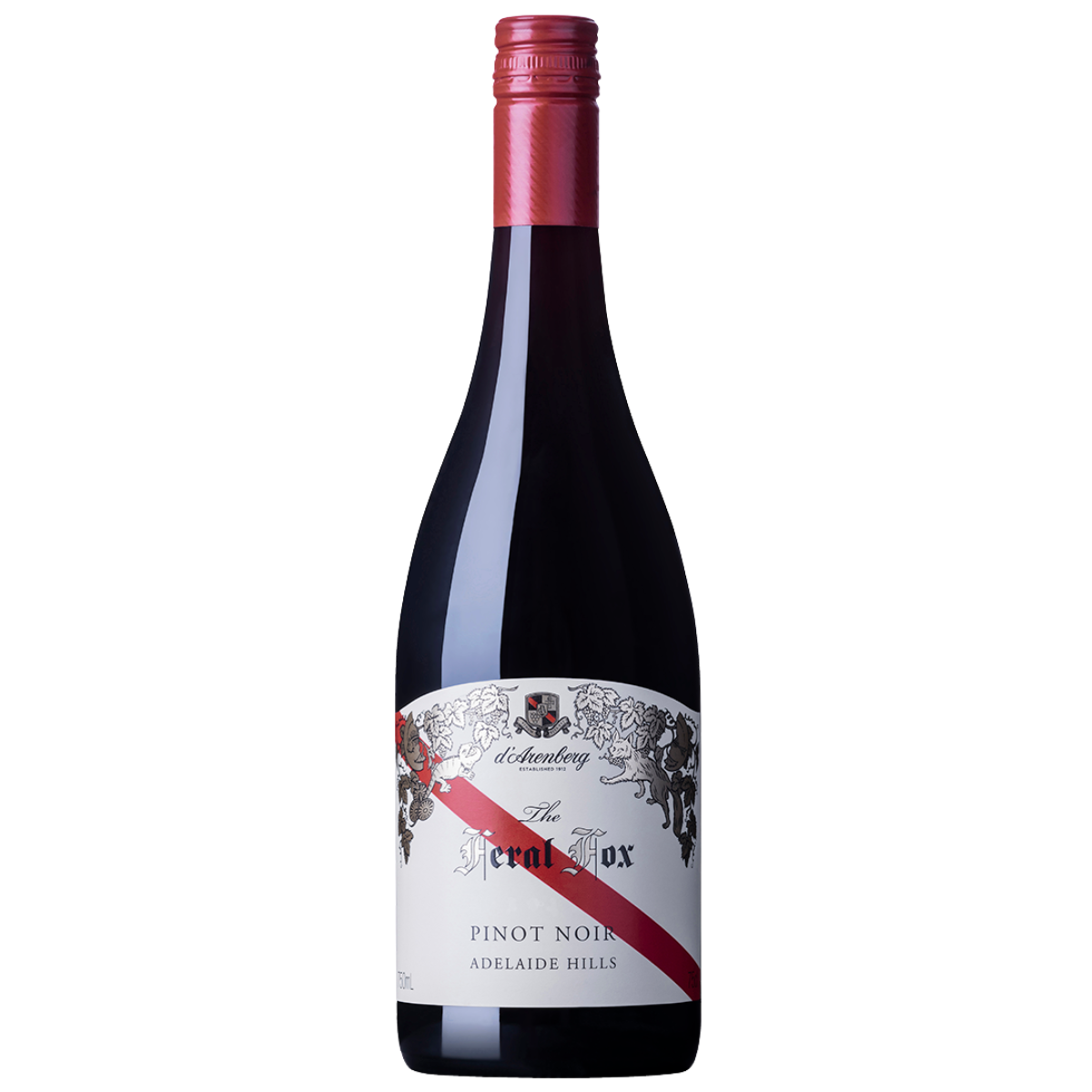
d’Arenberg The Feral Fox Pinot Noir is named after the feral foxes that inhabit the Adelaide Hills have developed an appetite for grapes and can often be found eating low hanging bunches during vintage. We’re not fussed though as these bushy tailed critters act as crop thinners and enhance the quality of grapes that are too high for them to reach. It also has the secondary effect of providing a natural source of fertilisation when the laxative nature of the grapes take effect on the normally carnivorous foxes.
The cool, wet 2022 winter filled the subsoil, while spring’s heavy rainfall impacted yields. Shaded basal buds and reduced fruitfulness from the previous season resulted in small yields. Mild, dry summer caused late veraison. Despite a week of intense heat in February, most vines survived. Riesling started three weeks late, and McLaren Vale Chardonnay and Sauvignon Blanc ripened with low yields due to the heat wave. Autumn was mild, and red grape harvest followed McLaren Vale Chardonnay, with variable, mostly low yields. Fiano, Marsanne, Roussanne, and Viognier ripened alongside the reds. Only 100 tonnes of red
varieties remained by Easter, with low yields in Adelaide Hills Chardonnay and Pinot. Dry white Chardonnay vineyards were used for sparkling wine, promising a great year.
Small batches of grapes are crushed gently and then transferred to two tonne headed down open fermenters. About 15% whole bunches are added and it undergoes approximately three days of cold soak prior to wild fermentation starting. Foot treading is undertaken on a regular basis throughout fermentation followed by gentle basket pressing. The wine is then transferred to older French oak barriques to complete primary and secondary fermentation. The wine is aged on lees for added complexity with no racking until final blending. The Feral Fox does not undertake fining or filtration prior to bottling.
A bright ruby in appearance. Lifted aromas of red cherries, strawberries, and blood orange, underpinned by subtle hints of mushroom and savoury meatiness. The palate bursts with vibrant flavours of blood orange, strawberries, and cherries. A tight, direct acid line drives the fruit cleanly across the palate, while juicy, well-integrated tannins add structure and complexity. A Pinot of elegance and finesse.
To see our full range of d’Arenberg product go to our dedicated web page
For more information on the d’Arenberg wines and winery click here.
d’Arenberg The Feral Fox Pinot Noir
£24.00 a bottle
9 in stock
d’Arenberg is an icon of the McLaren Vale, dating back to 1912. Chief winemaker Chester Osborn is the great-grandson of the founder, Joseph Rowe Osborn. Chester now oversees a stellar (and ever-expanding) range of strangely named and exquisitely crafted red and white wines.
The oldest of the d’Arenberg blocks were first planted in the 1880s with Shiraz, and still contribute to the wines today.”
The Adelaide Hills is one of Australia’s most charming wine regions and home to a large number of premium wine producers. The wine history of the area is similar to many other wine regions: industry developed after the first plantings in the 1840s, only to struggle for economic survival as consumer tastes changed with resurgence in the 1970s – most notably Brian Croser with Petaluma. Today it is very much a boutique vineyard and winery region that is pitching for quality and winning awards. This region has the coolest climate of all South Australian wine regions. Nestled in the Hills, its climate influenced by altitude (350m to 700m) and winds from the St Vincents Gulf. Main wine styles: White – Chardonnay, Sauvignon Blanc, Riesling; Red – Pinot Noir, Cabernet Sauvignon, Merlot, Shiraz.

d'Arenberg
Vegan
d'Arenberg
Vegan
d'Arenberg
Vegan
d'Arenberg
VeganThis website uses Cookies to improve your browsing experience. View Cookies Policy
I'm fine with this